


THE ZOMBIE LAYER: VOL 1 — The AI That Lives Outside the Workflow
Explains why simply giving employees ChatGPT or other AI tools hasn’t delivered enterprise productivity gains. This article explores the missing execution layer between AI access and real workflow integration, and why most organisations are stuck in surface-level adoption rather than true operational transformation.

The Cultural Intelligence Gap: Why "Local" AI fails Global Markets
Is your AI strategy "Local" or "Global"? AI FIXR founder Julie explains why inclusive data architecture is the key to winning global market share in 2026.
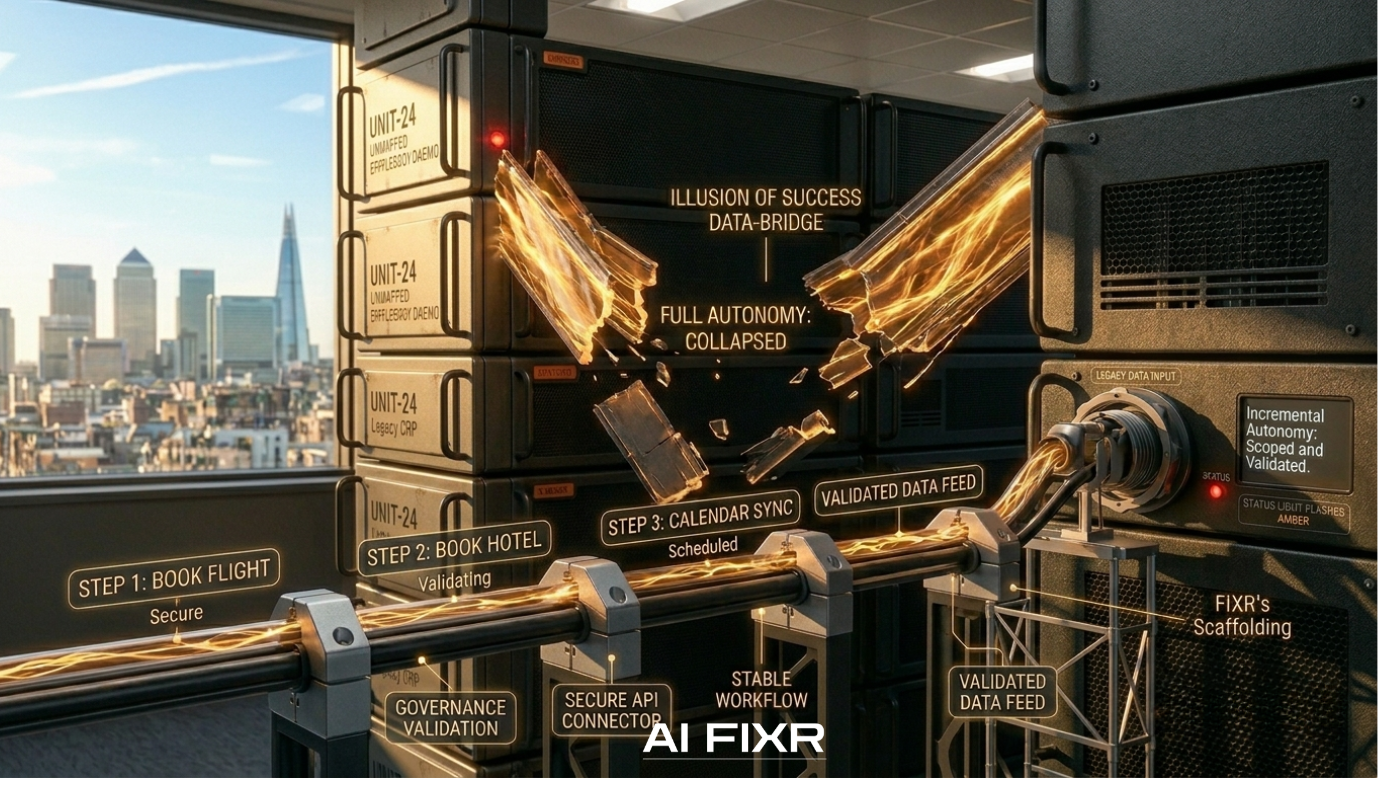
THE AI SHIFT: VOL 6 — Why Most Agentic AI Fails Before Production
Most Agentic AI projects fail before reaching production, not because the models lack capability, but because of gaps in execution, system integration, and enterprise readiness. This article explores the real reasons Agentic AI systems stall at the prototype stage, including missing infrastructure, unreliable tool use, weak governance, and the complexity of deploying AI into real-world environments.

THE AI SHIFT: VOL 5 — APIs vs LAMs: The Reality of Execution in Enterprise AI
Enterprise AI systems rely on execution layers to interact with real-world software. This article explores the difference between APIs and Large Action Models (LAMs), and how each enables AI systems to operate within enterprise environments. It breaks down the trade-offs between structured API-based integration and UI-driven execution, and why both approaches matter for scaling Agentic AI in practice.
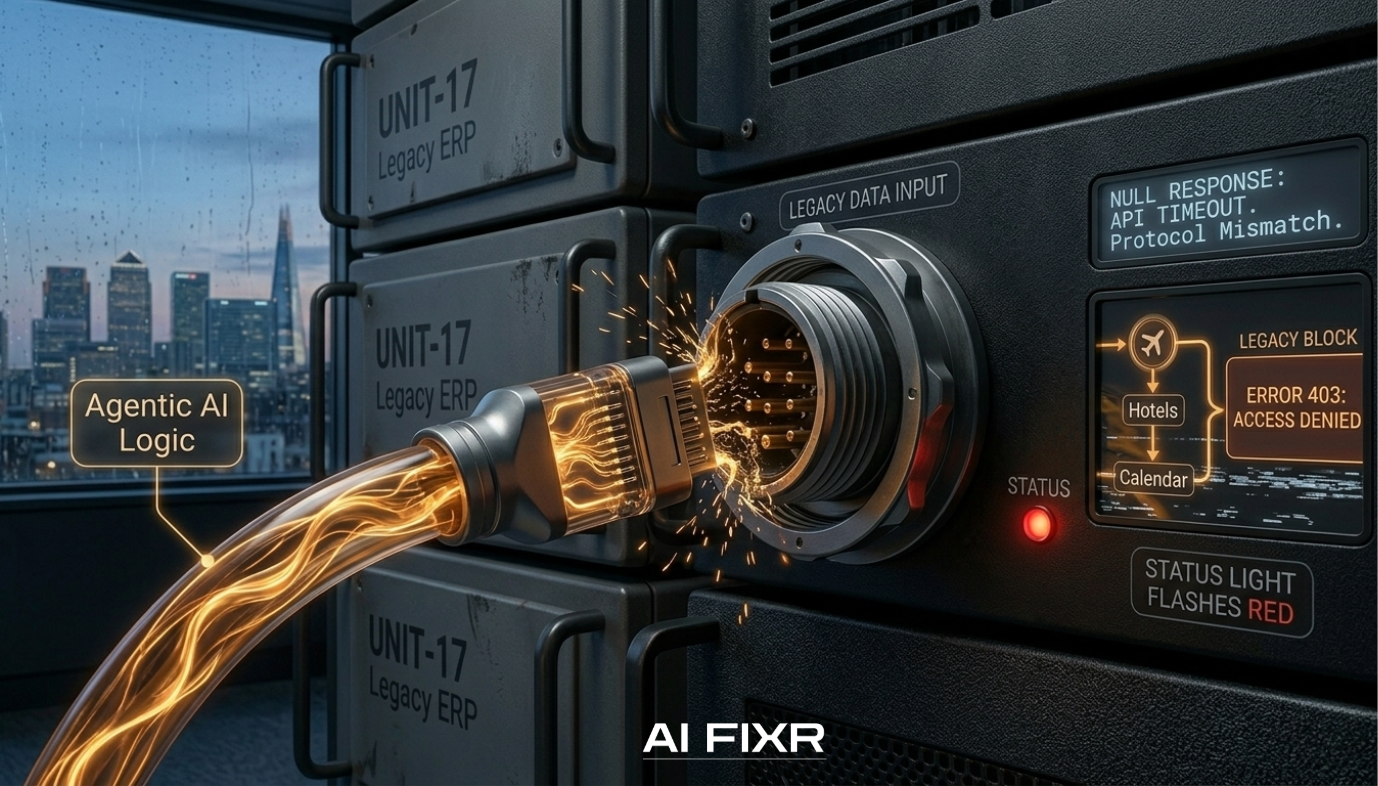
THE AI SHIFT: VOL 4 — What Breaks When Agentic AI Meets Real Enterprise Systems
Agentic AI systems often perform well in controlled environments, but break down when deployed in real enterprise systems. This article explores what actually fails when Agentic AI meets production environments, including data fragmentation, system integration issues, governance gaps, and workflow complexity that prevent autonomous systems from scaling in practice.

THE AI SHIFT: VOL 3 — From Thinking to Doing: Why Large Action Models (LAMs) are the 2026 "Action Risk"
AI is moving from chatting to executing. Julie, founder of AI FIXR, explains why Large Action Models (LAMs) require 10x stronger data governance to avoid "automated disasters."

THE AI SHIFT: VOL 2 — The Missing Execution Layer in Agentic AI
Agentic AI is often described as systems that can act autonomously, but most implementations fail at one critical point: execution. This article explores the missing execution layer in Agentic AI, the gap between reasoning and real-world system action, and explains why AI models struggle to operate inside enterprise environments without reliable infrastructure, tools, and integration layers.
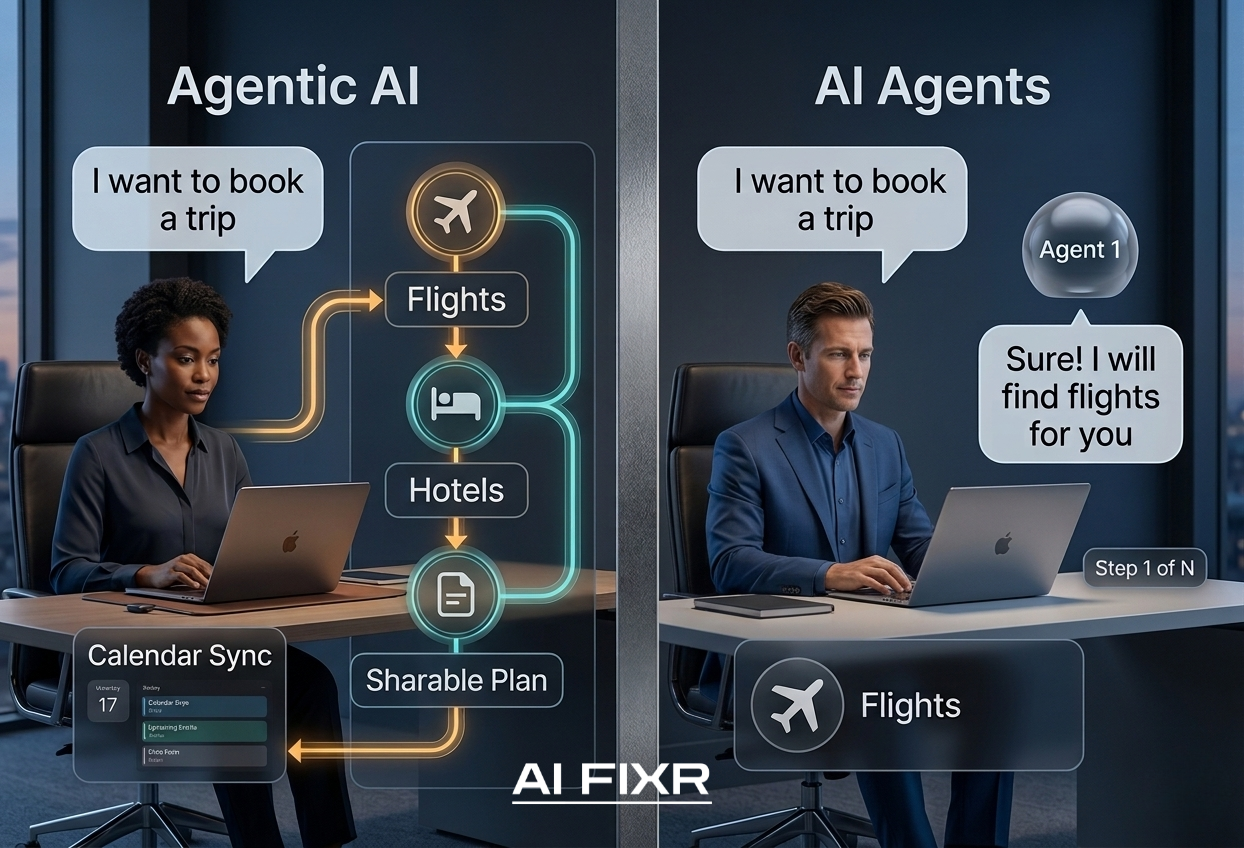
THE AI SHIFT: VOL 1 — What Agentic AI Is (and What People Get Wrong About It)
A professional landscape-oriented editorial photograph comparing Agentic AI and AI Agents in a corporate setting. The left side features a person at a desk with an autonomous, connected workflow diagram for travel planning. The right side features another person at a desk with a fragmented, step-by-step AI interaction.

AI FIXED: VOL 4 — The Lifeline in the Chat Box (The Ethical Guardrails)
AI, Fixed. Vol 4 tells the story of how a banking AI chat system was used by vulnerable customers as a discreet lifeline during situations of financial and domestic abuse. It highlights how standard automation workflows can unintentionally create risk, and how rebuilding AI with safety signals, human intervention, and protective design transforms it into a secure and supportive channel.

AI FIXED: VOL 3 — The Safety (The Hallucination that Could Have Ended a Contract)
AI, Fixed. Vol 3 examines how AI transcription tools fail in global B2B environments when they misinterpret accents and industry-specific language, producing confidently incorrect outputs. Through a real-world case, it reveals the operational and reputational risks of unchecked automation and how confidence thresholds, human-in-the-loop design, and domain calibration are essential to fixing AI systems.

AI FIXED: VOL 2 — The Trust (The Luxury of the 2-Minute Task)
AI, Fixed. Vol 2 explores a real-world case where AI tools introduced into a luxury environment technically worked but failed in practice. It tells the story of how staff spent more time correcting AI outputs than using them, revealing the hidden “correction tax” that appears when automation doesn’t align with high-context, high-trust workflows and how fixing it required precision, not replacement.

AI FIXED: VOL 1 — The Philosophy (The "Out-of-the-Box" Delusion)
AI, Fixed. Vol 1 looks at an AI implementation that worked technically but failed in practice inside a real company due to workflow, user adoption, and operational constraints.

WHAT A SUCCESSFUL AI PROJECT ACTUALLY LOOKS LIKE
A successful AI project is less about models and more about infrastructure, clarity, and execution. Learn what actually makes AI systems work in the real world from problem-first design and data pipelines to last-mile integration and ongoing maintenance.

WHY AI FAILS: VOL 5 — A Sector-by-Sector Breakdown (2026)
AI isn’t failing because it doesn’t work, it’s failing because organisations can’t implement it properly. This sector-by-sector breakdown of enterprise AI in 2026 explores where systems break most often, why pilot projects stall before production, and what this reveals about the gap between ambition and execution.
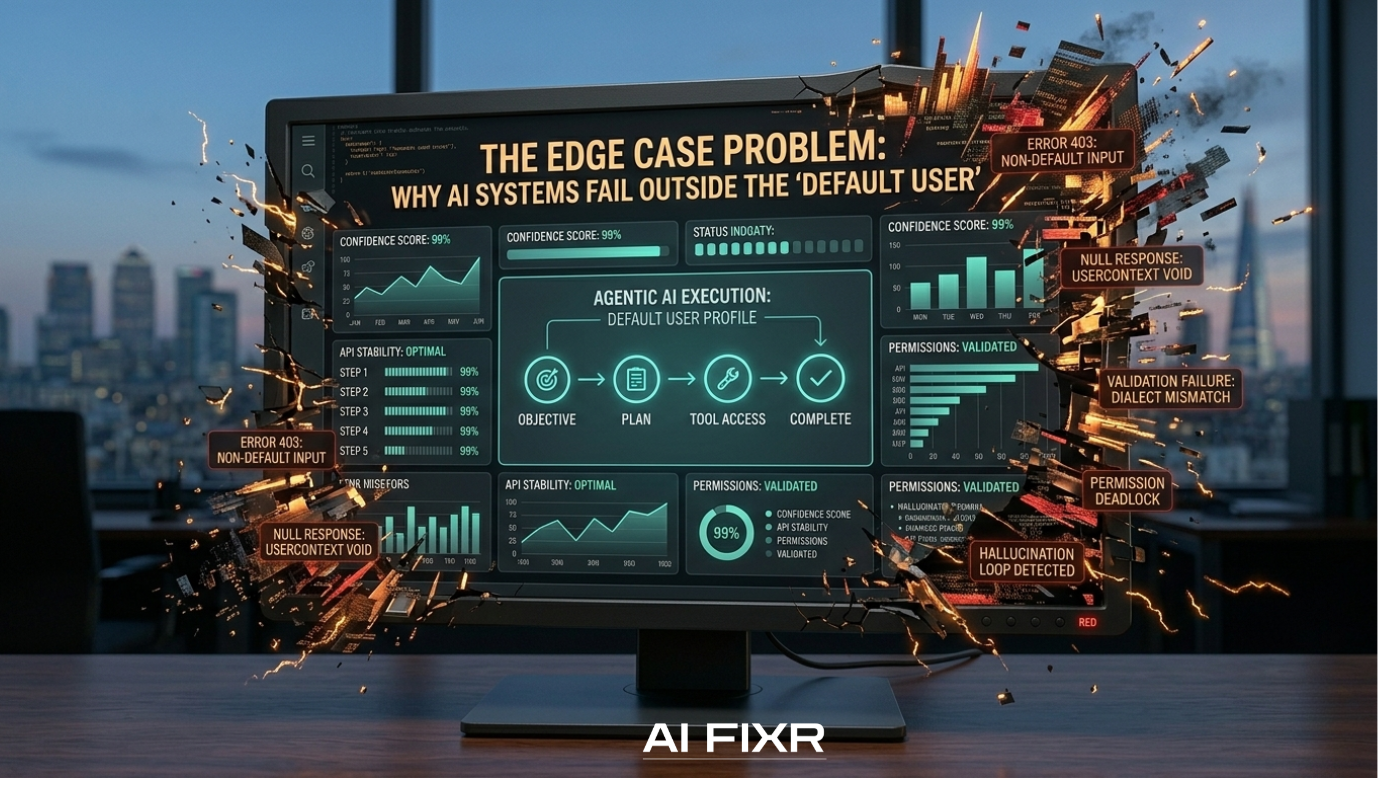
WHY AI FAILS: VOL 4 — The Edge Case Problem: Why AI Systems Fail Outside The “Default User”
AI systems often fail not because the technology is flawed, but because they are designed around a “default user” that doesn’t reflect real-world complexity. This article explores how edge cases expose hidden weaknesses in enterprise AI, creating performance gaps, bias risks, and operational failures when deployed in diverse, real-world environments.

WHY AI FAILS: VOL 3 — The Three Waves of AI: Why Your 2024 Foundation Won't Survive 2028
Are you building a skyscraper on a 2024 foundation? AI FIXR founder Julie explains the shift from Prototypes to the Agentic Standard and how to survive the Operational Reckoning.

WHY AI FAILS: VOL 2 — 95% of AI Pilots Are Dead on Arrival: The Forensic Autopsy
For the last few years, the corporate world has been in a "honeymoon phase" with AI. Boards were happy to fund experiments just to see what was possible. But in 2026, the mood has shifted. CEOs are no longer asking what AI can do; they are asking: "Where is the ROI?”

WHY AI FAILS: VOL 1 — Buying the $50k/month Ferrari of AI tools but trying to run it on vegetable oil.
Buying a $50k/month AI tool and feeding it fragmented data is like running a Ferrari on vegetable oil. Without Data Gravity, your 'Enterprise' AI is just an expensive paperweight. Learn why infrastructure debt is the silent killer of ROI and how to fix the fuel before you wreck the engine.