

WHAT A SUCCESSFUL AI PROJECT ACTUALLY LOOKS LIKE

A successful AI project often looks less like a sci-fi movie and more like a high-precision infrastructure upgrade. While the industry is littered with "proof of concepts" that never leave the lab, a project that actually works focuses on solving a specific friction point rather than chasing "innovation" for its own sake.
Here is a breakdown of what an AI project looks like when it is firing on all cylinders.
1. Problem-First, Not Model-First
The most common cause of failure is "a solution in search of a problem." A successful project starts with a boring, high-impact bottleneck.
The Sign of Success: You can describe the project’s goal without using the word "AI." (e.g., "We are reducing the time it takes to process an invoice from three days to ten seconds.")
Clear Key Performance Indicators (KPIs) are defined before a single line of code is written.
2. Operational Infrastructure over "Magic"
Successful AI is 10% model and 90% plumbing. When a project works well, the data pipelines are robust, and the "operational infrastructure" is invisible but reliable.
Clean Data Flow: Data isn't just "big"; it’s clean, labeled, and flows automatically from the source to the model.
The "FIXR" Mindset: Instead of focusing on "smart" features, the team focuses on error handling. What happens when the model is unsure? A successful project has a "human-in-the-loop" system to catch and fix edge cases.
3. The "Last Mile" Integration
An AI model is useless if it sits in a vacuum. Success is defined by how well the AI interacts with existing tools and people.
Seamless UI: The AI output is delivered exactly where the worker already spends their time (e.g., inside a CRM or an ERP system), not in a separate, clunky dashboard.
Trust and Transparency: The system provides "reasoning." If it flags a transaction as fraudulent, it highlights the specific cables and triggers that led to that conclusion so a human can verify it quickly.
4. Measured "Invisible" Maintenance
A successful AI project is never "done." Because data changes (a phenomenon known as Model Drift), a winning project has automated monitoring.
FIXR guide & SUMMARY: THE "OPERATIONAL" AESTHETIC
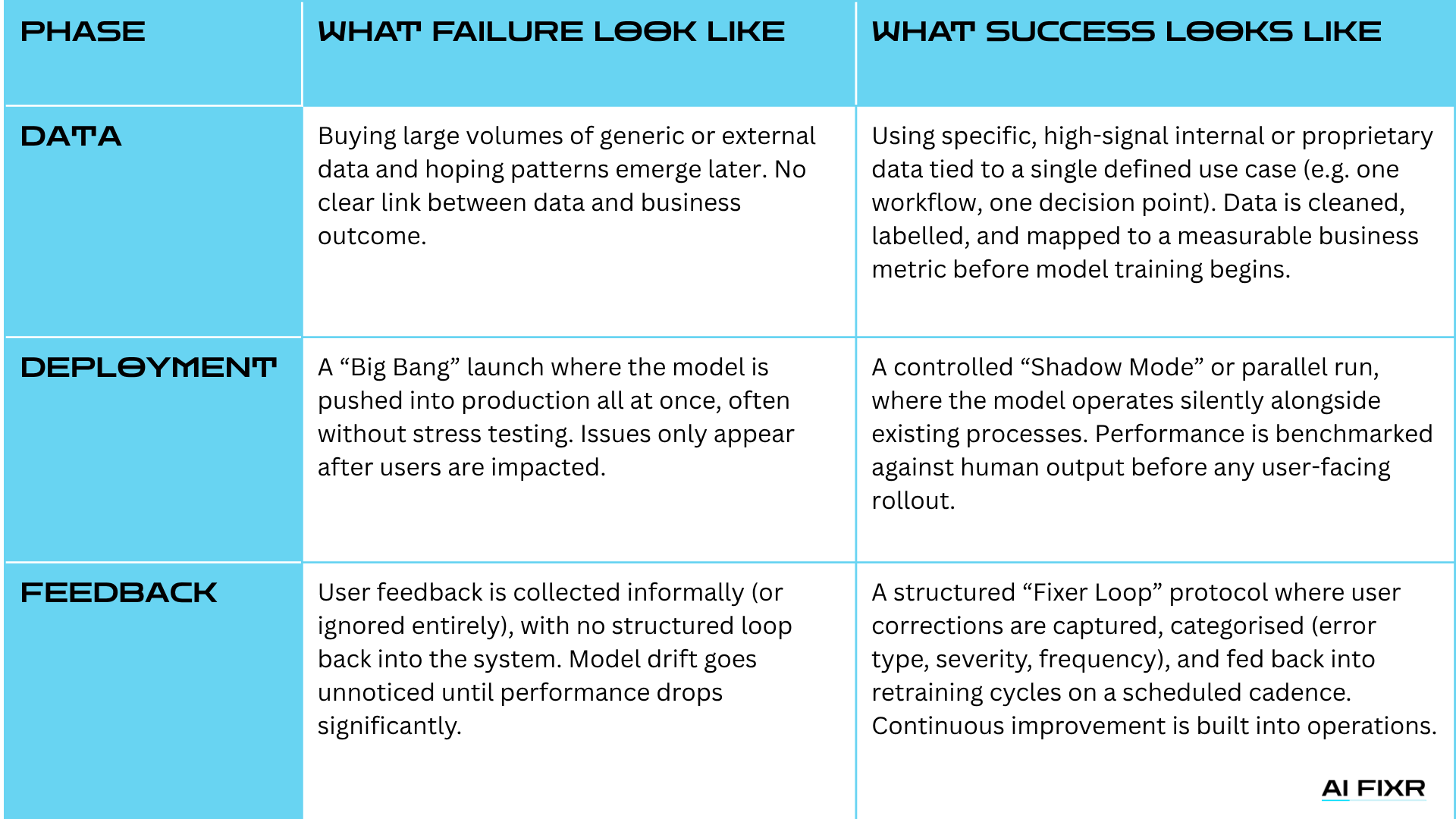
When all the ducks are in a row, an AI project feels stable and gritty rather than "glowy" and speculative. It’s about the precise interaction between complex math and physical business processes. It isn't about making the computer "think"; it’s about making the business run.
Do you want to focus this article on the technical side of the "plumbing," or more on the cultural shift required to get stakeholders on board?
