

THE AI SHIFT: VOL 6 — Why Most Agentic AI Fails Before Production
By this point, most organisations have heard the promise of Agentic AI.
Systems that can:
take goals
plan steps
use tools
and complete work autonomously
On paper, it looks like a shift from automation to autonomy.
But in reality, many Agentic AI initiatives fail before they ever reach production.
And the reason is not what most people expect.
1. The problem is not intelligence
Modern AI models are already capable of:
reasoning through complex problems
generating structured plans
and making decisions across multi-step tasks
So the failure point is rarely “can the AI think?”
It’s: can the system reliably operate in the real world?
2. The environment is the bottleneck
Agentic AI doesn’t fail in isolation.
It fails inside enterprise environments that are:
fragmented
inconsistent
full of legacy systems
and dependent on human-driven processes
So even when the AI is correct, the environment it operates in is not designed to support autonomous execution.
3. Execution is harder than reasoning
One of the biggest misconceptions is that intelligence is the hardest part.
In reality:
execution is the hardest part
Because execution requires:
system access
permissions
reliable integrations
stable workflows
and predictable outcomes
Without this, even perfect reasoning cannot translate into real impact.
4. Integration debt slows everything down
Most organisations underestimate how complex their system landscape is.
Common issues include:
too many disconnected platforms
inconsistent APIs
legacy systems with no integration layer
and hidden manual processes
This creates what is often “invisible complexity” — until you try to automate it.
That’s when projects stall.
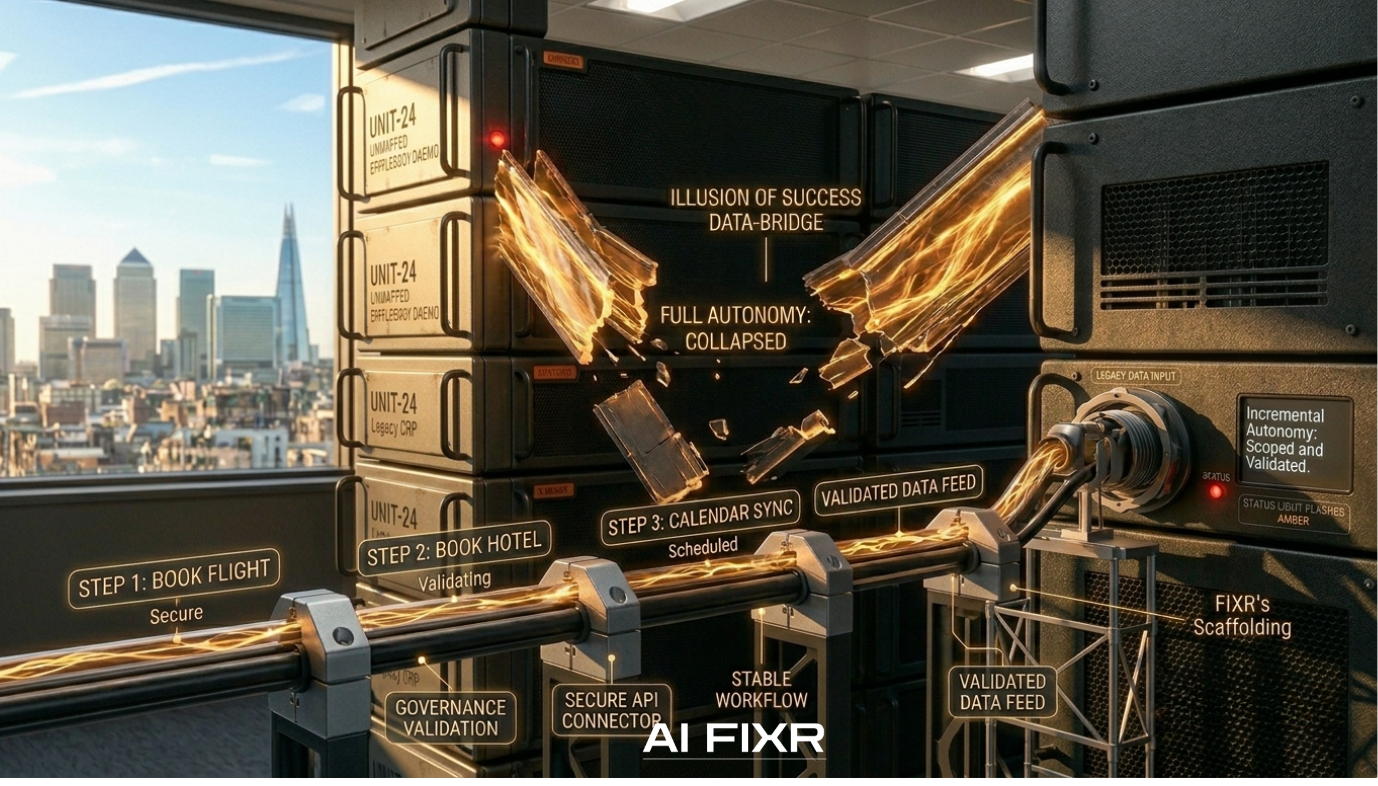
5. The illusion of success in demos
Many Agentic AI projects look successful in controlled environments.
Because demos typically have:
clean data
simplified workflows
perfect API access
and no edge cases
But production environments are the opposite:
messy, unpredictable, and constantly changing
So the gap between demo and reality becomes the failure point.
6. No execution safety layer
In production systems, mistakes are not theoretical.
They are operational:
incorrect actions
unintended system changes
financial or workflow errors
and broken processes
Without a robust execution safety layer (validation, approvals, rollback logic), organisations are understandably cautious to fully deploy autonomy.
The real reason Agentic AI fails
It’s not because the AI is not capable.
It’s because:
autonomy requires an environment that can safely support autonomy
And most enterprise systems were not designed for that level of independence.
What success actually looks like
Successful Agentic AI deployments tend to share one thing:
They are not fully autonomous.
Instead, they are:
tightly scoped
carefully integrated
heavily governed
and designed around execution constraints
They don’t try to replace systems.
They work within them.
fixr Final thought
Agentic AI is not failing because the idea is wrong.
It is struggling because reality is more complex than the architecture assumes.
The future is not fully autonomous systems overnight.
It is incremental autonomy built on top of messy, real-world infrastructure.
And the organisations that understand that difference early will be the ones that actually make it work.
If you’re exploring Agentic AI but unsure how it actually behaves in real enterprise environments, I offer short AI Fix Sessions where we map where execution breaks in your current systems — from APIs to workflows to data foundations.
→ Book a 1:1 AI Fix Session to understand what would actually stop Agentic AI from working in your organisation.
