

THE AI SHIFT: VOL 5 — APIs vs LAMs: The Reality of Execution in Enterprise AI
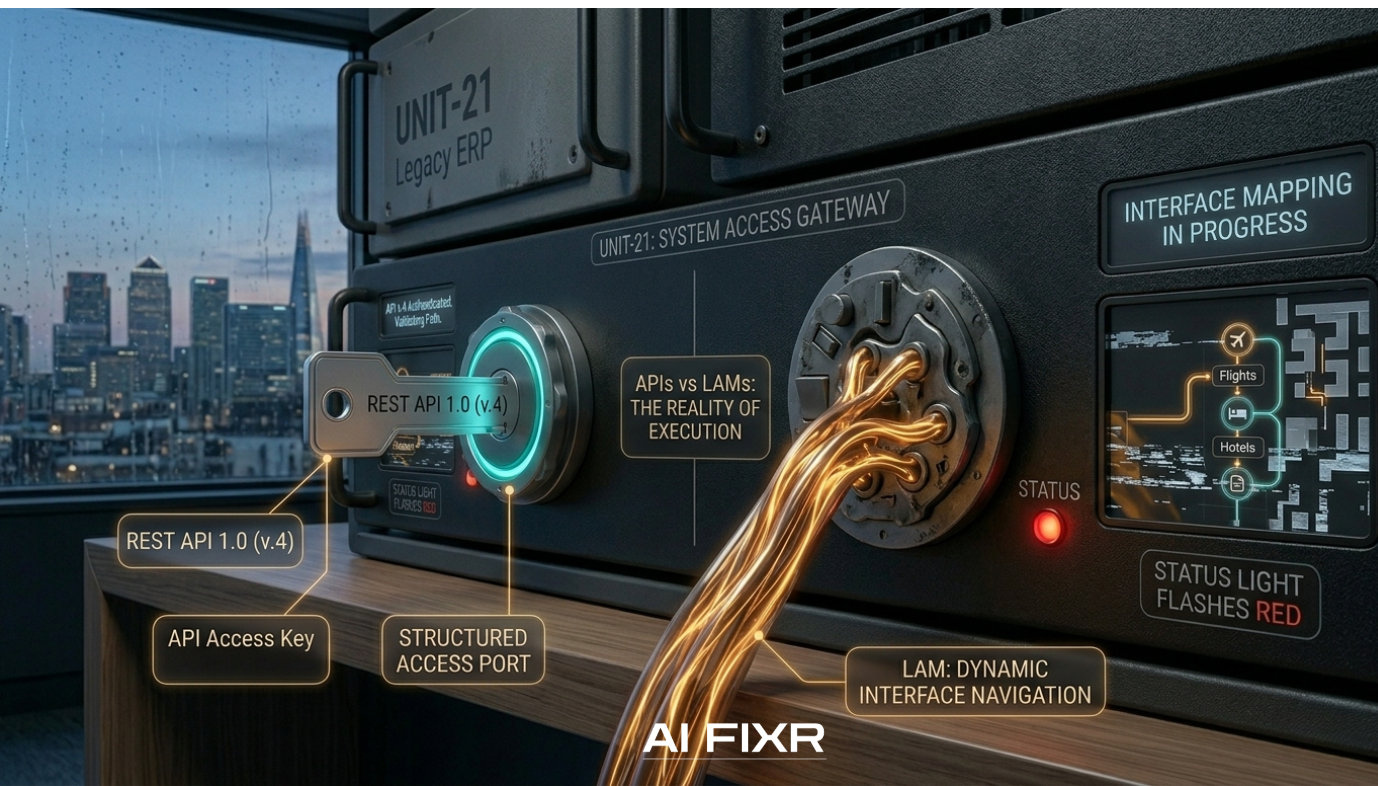
Once you understand Agentic AI and the execution challenges in enterprise systems, one question becomes unavoidable:
How do AI systems actually interact with software in the real world?
In practice, there are two primary ways — and they are very different in reliability, structure, and scalability.
1. APIs: the structured execution layer
APIs are the ideal way for AI systems to interact with software.
They provide:
structured inputs and outputs
predictable behaviour
fast execution
and clear auditability
When an AI system uses an API, it is communicating directly with the system in a machine-native way.
This is:
clean, reliable, and scalable execution
The limitation of APIs
The problem is simple:
not every system has a usable API
In enterprise environments, many systems are:
legacy platforms
partially integrated
or built before API-first design was standard
So while APIs are the preferred route, they are not always available.
2. LAMs: the fallback execution layer
This is where Large Action Models (LAMs) come in.
LAMs allow AI systems to interact with software through the user interface — essentially behaving like a human using a screen.
Instead of calling an API, the system:
sees the interface
identifies elements on the screen
clicks buttons
fills forms
and navigates workflows
In simple terms:
LAMs allow AI to “use software like a person would”
Why LAMs matter
LAMs become critical when:
no API exists
systems are legacy or closed
or integration is too slow or expensive
They unlock access to systems that would otherwise be unreachable.
The trade-off: flexibility vs reliability
APIs and LAMs sit on opposite ends of a spectrum:
APIs
highly reliable
fast
structured
easy to scale
but limited by availability
LAMs
highly flexible
can work with almost any system
but slower and more fragile
dependent on UI stability
So the choice is not about which is better — it is about what is available.
Where Agentic AI fits
Agentic AI systems often need both.
Because real enterprise environments are mixed:
some systems are API-ready
others require UI interaction
and many require a combination of both
So execution becomes a routing problem:
which method gets the job done most reliably in this environment?
The real shift happening now
The future of Agentic AI is not “API vs LAM”.
It is:
intelligent systems that can decide how to execute a task depending on the environment
That means:
use APIs when available
use LAMs when necessary
and adapt dynamically between both
Fixr Final thought
APIs represent the ideal world of structured machine-to-machine communication.
LAMs represent the reality of today’s enterprise systems.
Agentic AI sits between the two — trying to bridge the gap between how systems should work and how they actually work.
If you’re exploring Agentic AI but unsure how it actually behaves in real enterprise environments, I offer short AI Fix Sessions where we map where execution breaks in your current systems — from APIs to workflows to data foundations.
→ Book a 1:1 AI Fix Session to understand what would actually stop Agentic AI from working in your organisation.
