

THE AI SHIFT: VOL 4 — What Breaks When Agentic AI Meets Real Enterprise Systems
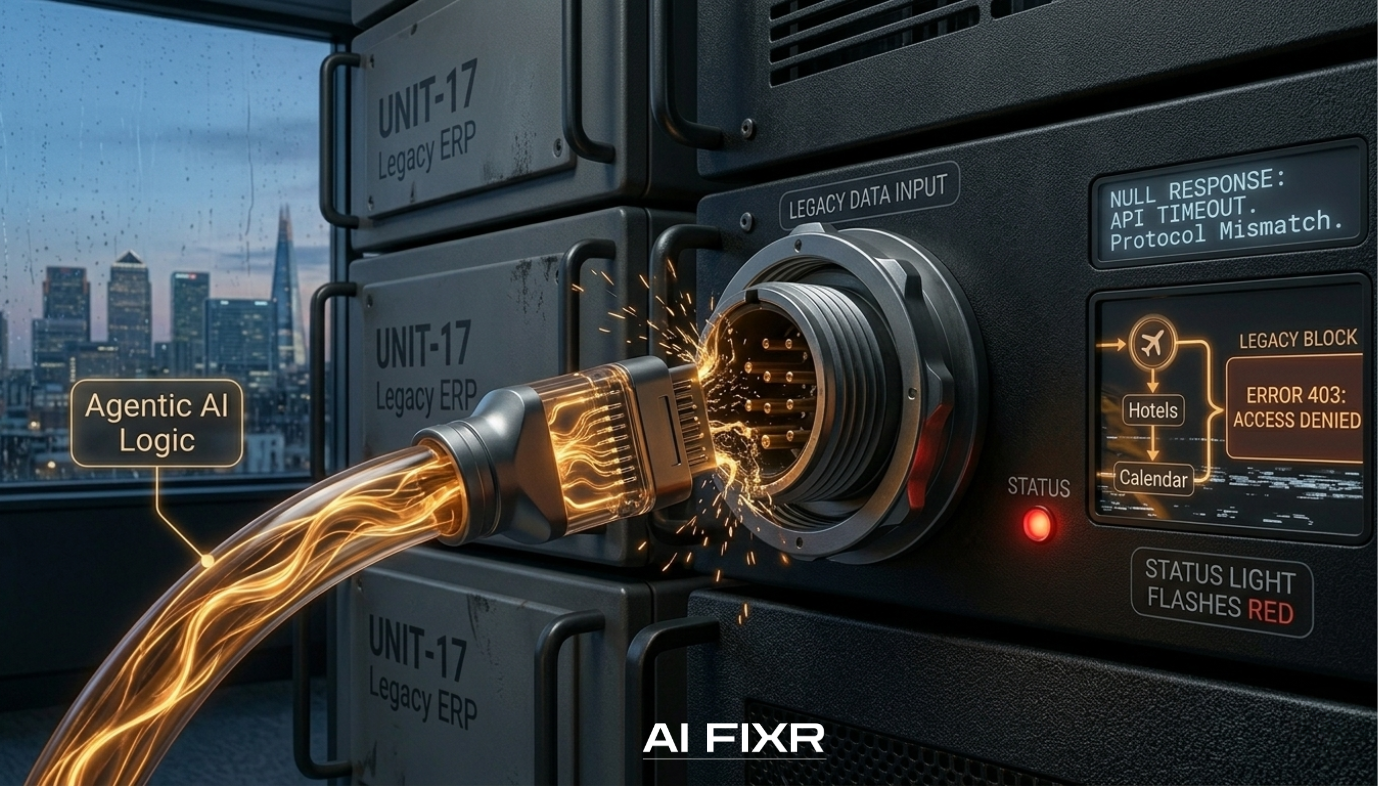
On paper, Agentic AI looks simple.
You define a goal, the system plans the steps, and it executes the work.
But in real enterprise environments, things rarely work that cleanly.
Because Agentic AI doesn’t operate in isolation, it has to plug into complex, fragmented, and often outdated systems.
And that’s where the problems begin.
1. Systems were never designed for agents
Most enterprise systems were built for humans, not machines making autonomous decisions.
That means:
workflows are manual
processes are inconsistent
interfaces assume human judgement
and logic is often spread across multiple systems
So when an AI agent tries to operate across them, it isn’t entering a structured environment — it’s entering operational chaos.
2. Data is fragmented, not unified
Agentic AI relies heavily on access to accurate, connected data.
But in most organisations:
data sits in silos
systems disagree with each other
definitions vary across teams
and “one version of truth” doesn’t exist
So even if the agent makes the right decision, it may be acting on incomplete or inconsistent information.
3. Permissions and security slow everything down
Agentic AI systems need access to do meaningful work.
But enterprise environments are built around:
strict access controls
approval chains
compliance requirements
and auditability
So instead of “autonomous execution,” you often get:
blocked actions, escalations, and partial automation
4. APIs are incomplete or inconsistent
In theory, APIs are the clean execution layer.
In reality:
not every system has an API
some APIs are poorly documented
some only expose partial functionality
and many legacy systems are API-light or API-less
This creates uneven capability across the organisation — where some tasks are fully automatable and others are not touchable at all.
5. Context gets lost between systems
Agentic AI works best when it has continuity of context.
But in real enterprise environments:
each system holds different parts of the workflow
information gets re-entered multiple times
and context rarely flows end-to-end
So the agent is constantly reconstructing understanding across disconnected systems.
6. Failure is not graceful
When Agentic AI works in controlled environments, it can recover from errors.
But in enterprise systems:
a small mistake can trigger real-world consequences
actions are often irreversible (payments, updates, communications)
and error recovery paths are not always defined
So failures are not just technical — they become operational risks.
The core issue: mismatch between intelligence and environment
Agentic AI is designed for structured execution.
Enterprise systems are often:
unstructured, inconsistent, and historically layered
That mismatch is where most real-world friction happens.
Why this matters
This is why many Agentic AI pilots look impressive in demos but struggle in production.
It’s not a model problem.
It’s an environment problem.
The intelligence is often there, but the system it is operating inside is not ready for it.
Fixr Final thought
Agentic AI doesn’t fail because it is too advanced.
It struggles because the systems it needs to operate in were never designed for autonomous execution.
Until enterprises close that gap, Agentic AI will remain powerful in controlled settings — but inconsistent at scale.
If you’re exploring Agentic AI but unsure how it actually behaves in real enterprise environments, I offer short AI Fix Sessions where we map where execution breaks in your current systems — from APIs to workflows to data foundations.
Book a 1:1 AI Fix Session to understand what would actually stop Agentic AI from working in your organisation.
